AI Just Got Very Good at Finding Software Flaws. Here’s What Your Company Actually Needs to Know.
A plain-language executive briefing on Project Glasswing and the systems companies like Visa, Capital One, and Cloudflare have built around it — what it means for budgets, staffing, and risk, with no engineering background assumed.
The one-paragraph version
In April 2026, Anthropic — the AI company behind Claude — revealed that one of its unreleased AI models had become remarkably good at finding security flaws in software: it discovered bugs that had gone unnoticed for 27 years, largely without human help [7]. Rather than keep it quiet, Anthropic launched Project Glasswing, giving the model to defenders first — Amazon Web Services, Apple, Cisco, Google, Microsoft, JPMorganChase, and more than 40 other organizations — along with up to $100 million in usage credits, so the companies protecting critical software get the advantage before attackers catch up [7]. This briefing reviews what five of those organizations actually built with it, and what a business leader should take away.
Why this matters to you, even if you don’t run a software company
Every company runs on software, and every piece of software has flaws. Until recently, finding those flaws was slow, expensive, expert work — which meant most flaws stayed hidden, for attackers and defenders alike. That equilibrium just ended. As CrowdStrike’s chief technology officer put it at the Glasswing launch: “the window between a vulnerability being discovered and being exploited by an adversary has collapsed… what once took months now happens in minutes with AI” [7].
At the same time, the people needed to deal with what AI finds are in critically short supply. There were roughly 4.8 million unfilled cybersecurity jobs globally in 2025 [12]. Nearly six in ten security professionals surveyed said they were considering leaving the field, citing exhaustion [11]. So the industry’s real problem isn’t finding flaws anymore — it’s keeping up with everything that gets found. That’s the problem the systems in this review were built to solve, and it’s a staffing and budget problem before it’s a technology problem.
What these companies actually built, in plain terms
An AI model on its own is like a brilliant consultant with no memory: give it a huge codebase and it loses track of what it was doing partway through. So each organization built what engineers call a “harness” — think of it as an assembly line wrapped around the AI, breaking the work into small, checkable steps.
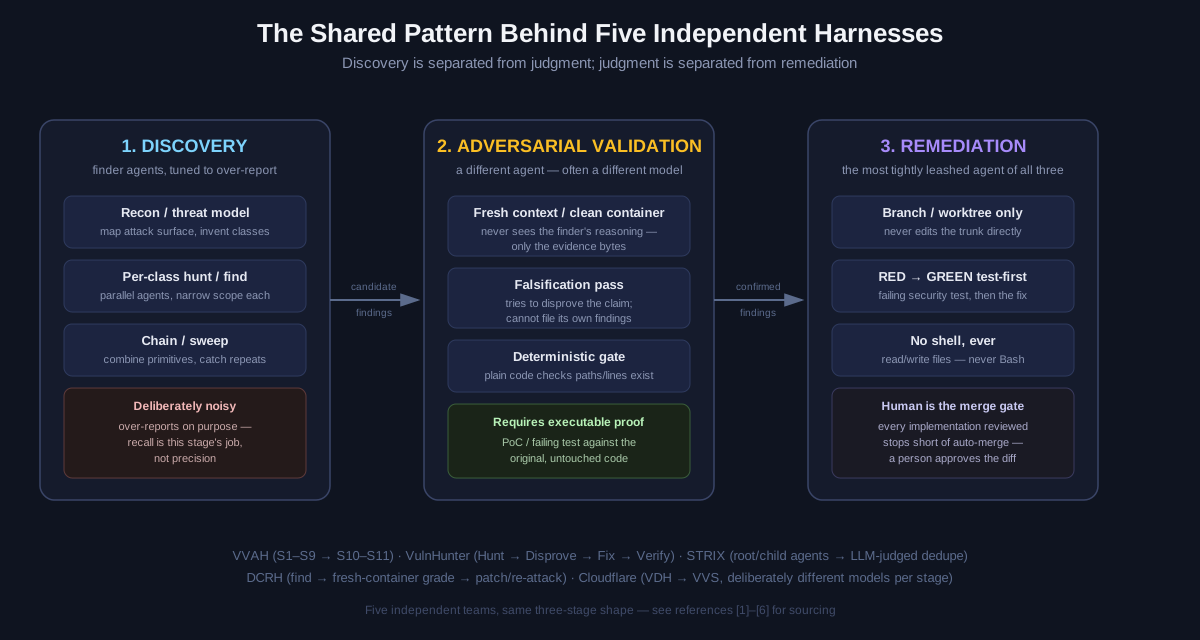
Five organizations built one independently: Visa (its Vulnerability Agentic Harness, “VVAH”), Capital One (a tool called VulnHunter), Anthropic itself (a reference blueprint called the Defending Code Reference Harness, “DCRH”), Cloudflare (an internal system scanning over 128 of its own code repositories), and an independent open-source project called STRIX [1][2][3][4][5][6]. Remarkably, all five converged on the same three-station assembly line, without coordinating:
- A finder — AI agents hunt for possible flaws, deliberately erring on the side of flagging too much.
- An independent checker — a separate AI, often a completely different model, tries to disprove each claimed flaw. Nothing counts unless it can be demonstrated with working proof. As Cloudflare put it: if the finder grades its own homework, it approves everything [6].
- A tightly limited fixer — an AI drafts the repair, but with sharply restricted permissions, and a human always approves before any change goes live. All five companies, independently, refused to let the machine push code on its own.
That last point is the headline for any board: even the most aggressive adopters — a card network, a bank, a frontier AI lab — all kept a human as the final gate. That’s the current industry standard of care, and it’s a reasonable benchmark to hold your own teams and vendors to.
Does it work? The honest numbers
Cloudflare published the only complete scorecard. Across its fleet, the system generated 20,799 possible flaws, which independent checking and de-duplication reduced to 7,245 real, actionable findings — and as the system matured, the rate of wasted (rejected) findings fell from 40% to 11% [6]. For a typical mid-sized codebase, the full cycle — finding flaws, verifying them, and drafting fixes — ran in about 14 hours [6]. Work that previously took specialist teams weeks.
Two honest caveats. First, cost: these systems consume significant AI computing budget, and the teams running them say the right comparison isn’t “is it free” but “what would the same assurance cost in human expert time” — where the math currently favors the machine, if false alarms are kept low. Second, limits: no one — including these companies — can tell you what the system missed. There is no complete inventory of every flaw in any codebase, so claims of “we catch everything” are unverifiable by definition. Treat any vendor claiming otherwise with suspicion.
The catch nobody has solved yet
Every one of these systems assumes you can fix what you find — that the flawed code is yours. But modern software is mostly assembled from free, open-source components maintained by outsiders, often volunteers. When the AI finds a flaw there, your company can’t ship the fix; you wait on someone else, sometimes a chain of someones. During the infamous Log4Shell incident, more than 80% of affected software packages couldn’t fix themselves directly — they were waiting on a component of a component [21]. Three years later, roughly one in eight applications was still running the vulnerable version [22]. Worse, about half of commercial codebases contain components that nobody actively maintains at all [23].
So AI is about to dramatically increase how many flaws get found in software your business depends on, while doing little yet to speed up how fast they get fixed — and the funding follows the same imbalance: Glasswing committed up to $100M to finding, and $4M to helping the volunteer maintainers who do the fixing [7]. For your risk register, that means: expect the queue of known-but-unfixed issues in third-party software to grow industry-wide, and ask your teams how your company’s exposure to that queue is tracked.
There’s a second, related gap. Traditional security-scanning tools that check code the old-fashioned way already share their results using a common format called SARIF — think of it as a standard shipping label that lets different security tools and different companies read the same list of problems, no matter who found them [25]. These new AI systems don’t have an equivalent yet: each one packages up what it found in its own private way, so results from one company’s AI scanner can’t easily be combined with another’s. Combine that with the lack of a shared way to coordinate fixes across the many outside software components a company depends on, and you get two gaps executives should expect the industry — including well-funded startups — to compete to close over the next year or two.
If you build your own, the tool itself becomes a target
Several of these systems are free to download, so many companies will run their own copy. Worth knowing at the executive level: the tool itself is sensitive and needs protecting, not just pointed at your code. It runs untrusted code to test for flaws, it holds the keys to your software systems, and — most importantly — it builds a database of confirmed, unfixed security holes in your own products, complete with working instructions to exploit them. If that database leaks, you’ve handed an attacker a ready-made target list. The companies that built these tools are security teams who locked them down carefully; a company that copies the design gets the capability but not automatically the protection. So if your teams stand one up, the tool belongs on your list of crown-jewel systems — access-controlled, encrypted, and included in your own security testing — from day one, not after an incident.
Five questions to ask your CISO or CTO
- Are we using AI-assisted vulnerability discovery yet — and if not, what’s the plan? The tools exist, several are free and open source, and your competitors and your attackers both have access to them.
- When AI finds and drafts a fix, who approves it? The correct answer today involves a named human before anything ships. If the answer is “it’s fully automatic,” probe hard.
- What do we measure? Mature teams track the cost per verified finding, the false-alarm rate over time, and how many machine-drafted fixes humans actually accept — not raw counts of “flaws found,” which reward noise.
- What’s our exposure to open-source components nobody maintains? This is the growing, unsolved half of the problem, and it won’t show up in a demo.
- Are we budgeting for the fixing, not just the finding? Discovery is getting cheap. Triage and repair capacity — people — is the scarce resource. Budgets that fund scanning without funding response recreate Glasswing’s own imbalance inside your company.
The bottom line
Five sophisticated organizations independently built the same machine, which tells you the design is sound and the direction is set: AI finds, AI checks, AI drafts, humans decide. Adoption is now a management question — governance, metrics, and staffing the response side — more than a technology bet. The organizations that get ahead of this won’t be the ones that find the most flaws. They’ll be the ones that built the capacity to act on what gets found.
References
- Visa, Visa Vulnerability Agentic Harness (VVAH), github.com/visa/visa-vulnerability-agentic-harness — open-sourced June 10, 2026 under the Apache License 2.0 (© 2026 Visa, Inc.). Reviewed design documentation.
- Capital One, VulnHunter, github.com/capitalone/VulnHunter. Reviewed design documentation.
- STRIX, open-source autonomous penetration-testing agent — architecture and design documentation reviewed for this piece. Reviewed design documentation.
- Anthropic, Defending Code Reference Harness (DCRH), github.com/anthropics/defending-code-reference-harness. Reviewed design documentation.
- Cloudflare, “Project Glasswing: what Mythos showed us,” The Cloudflare Blog, May 18, 2026.
- Cloudflare, “Build your own vulnerability harness,” The Cloudflare Blog, June 18, 2026.
- Anthropic, “Project Glasswing: Securing critical software for the AI era,” April 7, 2026.
- ISC2, 2025 Cybersecurity Workforce Study.
- DeepStrike, “Cybersecurity Skills Gap Statistics for 2025.”
- Open Source Insights (deps.dev), “Understanding the Impact of Apache Log4j Vulnerability.”
- Vulert, “Log4Shell 2026: Is Your Application Still Vulnerable?”
- Black Duck / Synopsys, 2026 OSSRA Report.
- OASIS, Static Analysis Results Interchange Format (SARIF) v2.1.0, docs.oasis-open.org/sarif/sarif/v2.1.0.
Full source list, including all five harnesses’ architecture citations, in the companion piece: “Inside Project Glasswing: How Five Independent Teams Built the Same Machine.”