Graph Intelligence — How the Graphs Were Built
To understand the harness we ran two local, no-API-key code-intelligence tools over a clone
of the repository and used their output to drive the diagrams and the component map. Their raw
exports live under tool-outputs/.
These tools read all the code and build a map of how everything connects — which function calls which, which file imports which. That map is what let us draw an accurate "component dependency" picture instead of guessing, and it is exactly the kind of index an AI coding assistant can query to answer "how does X work?" without re-reading the whole codebase every time.
What we ran (locally, in the sandbox)
CodeGraph (@colbymchenry/codegraph v1.5.0)
A tree-sitter + node:sqlite knowledge-graph builder. We indexed the repo and exported the
results.
| Metric | Value |
|---|---|
| Files indexed | 180 (177 Python + 2 YAML + 1 Go fixture) |
| Nodes | 4,538 (function 1,701 · method 1,030 · import 967 · variable 347 · class 314 · file 178) |
| Edges | 10,362 (contains 4,360 · calls 3,653 · imports 941 · references 751 · instantiates 652 · extends 5) |
Outputs: tool-outputs/codegraph/ — the SQLite DB (db/),
files.json, god_nodes.json, status.txt, and module_dependencies.json (the
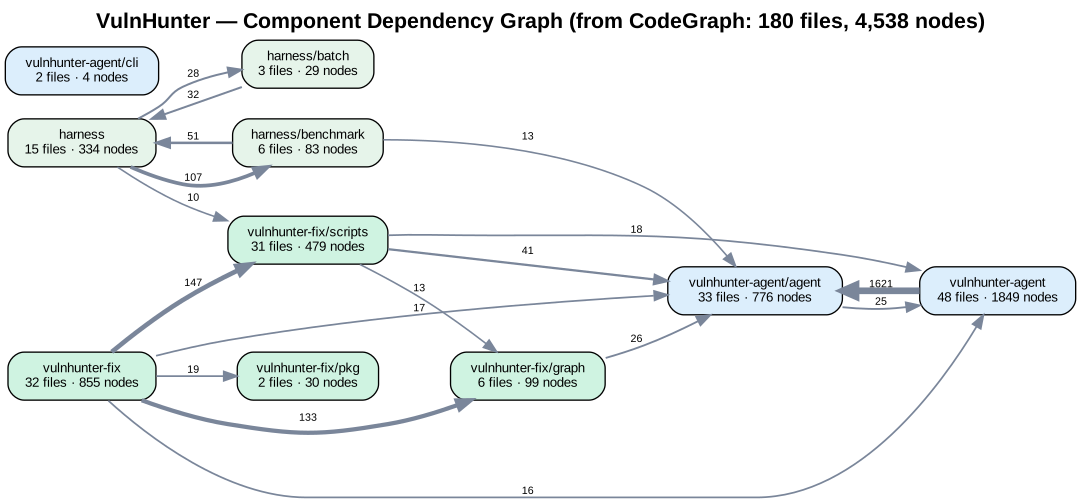
aggregated component-to-component edges that power
diagrams/04_module_dependencies.svg and
diagrams/module-graph.html).
Highest-connected ("god") symbols confirm the design: the runtime agent's config _resolve,
RepoProperties, stream set_verbosity, redact, and the token/URL helpers dominate —
consistent with a config-and-transport-heavy automation layer wrapping prompt-only skills.
Graphify (graphifyy v0.9.x)
A NetworkX + Leiden + tree-sitter knowledge-graph builder that also emits an interactive HTML view and a report. We ran the code (AST) pass with clustering — no LLM/API key.
| Metric | Value |
|---|---|
| Nodes | 4,970 |
| Edges | 11,539 |
| Communities | 263 |
Outputs: tool-outputs/graphify/ — GRAPH_REPORT.md,
graph.json, graph.labeled.json, analysis.json, and the raw graph.html.
On Graphify's "Community N" clusters. Graphify groups the ~4,970 symbols into 263 "communities" (code that calls each other a lot). We named every cluster deterministically — from each cluster's dominant module plus its representative classes/functions — and produced a readable view:
tool-outputs/graphify/labeled-clusters.html. Because VulnHunter is heavily tested, several of the largest communities are test suites; the production communities cluster cleanly by component (agent internals, fixer scripts, harness).
Readable interactive views we built
Because the raw graph exports are dense, we built human-navigable views (all use native HTML
<details>, so they expand with or without JavaScript):
| File | What it gives you |
|---|---|
tool-outputs/codeviz/vulnhunter-skill-explorer.html |
The closed loop Hunt→Fix→Verify + runtimes; each box → phases → files. Best entry point. |
tool-outputs/codeviz/vulnhunter-codeviz.html |
Full drill-down: module → file → function, with plain-English notes. |
diagrams/module-graph.html |
Clickable 10-component flow; expand a box for role/inputs/outputs/deps. |
tool-outputs/graphify/labeled-clusters.html |
Graphify's 263 clusters, each with a human name. |
The reusable generator is tools/codeviz/ (codeviz.py works on any
Python repo; see its README).
The two tools we did not run here (need your local setup)
Both are designed to run inside your own AI client with local providers. Run them against a local clone of the repo.
Serena (oraios/serena) — LSP-backed semantic code tools
Serena needs language servers (e.g. a Python LSP) and is driven by an LLM over MCP.
uv tool install -p 3.13 serena-agent
serena init
# Point your MCP client (Claude Code / Cursor) at Serena, then over the vulnhunter-agent/agent
# and vulnhunter-fix/ packages use find_symbol / get_symbols_overview / find_referencing_symbols
# for symbol-level navigation and safe refactors.
Value here: precise symbol overviews and cross-file reference lookups on top of the Python
language server — ideal for a developer changing a shared contract (e.g. the manifest schema or
AgentConfig).
grepai (yoanbernabeu/grepai) — semantic code search
grepai needs an embedding provider (Ollama by default, or OpenAI).
brew install yoanbernabeu/tap/grepai      # or the install.sh one-liner
ollama pull nomic-embed-text
cd VulnHunter && grepai init && grepai watch &
grepai search "where is the auth token chosen for Claude"     # → agent/build_settings.py, auth.py
grepai search "the falsification pass that disproves findings" # → vulnhunt/phases/phase2b_verify.md
grepai trace callers "run_vulnhunt"
Value here: ask questions by meaning ("authorization bypass", "delivery gates") and get the relevant code even when names differ — and far fewer tokens for an AI agent.
How to refresh these graphs after code changes
codegraph index /path/to/VulnHunter --force        # CodeGraph
python tools/codeviz/codeviz.py --root /path/to/VulnHunter --name "Capital One VulnHunter" --exclude tests
# Graphify: re-run the extract → build → cluster → export pipeline (AST pass, no LLM).
These tools all target the same goal from different angles: turn a large codebase into a queryable graph so humans and AI agents can navigate it cheaply. CodeGraph and Graphify gave us the concrete numbers and the component map; Serena and grepai shine when wired into your own agent for day-to-day navigation and refactoring.