Data Flow (DFD)
This document traces what data moves through Visa Vulnerability Agentic Harness (VVAH), at three levels of zoom. The labelled artifact on each arrow is the most useful thing to memorise as a newcomer.
Rendered images:
03_context_dfd.svg(L0),02_dataflow_pipeline.svg(L1),06_remediate_validate.svg(S10/S11).
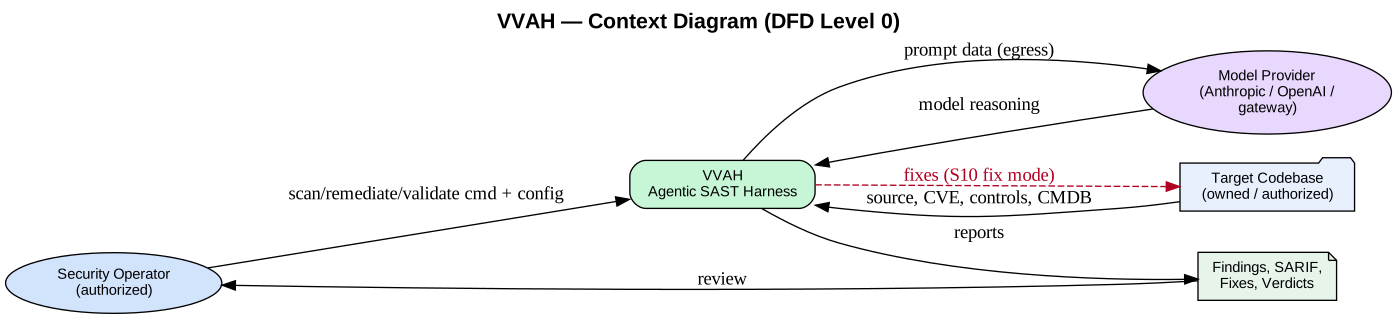


Data enters as code plus context. It is progressively refined: raw code becomes a map, the map becomes a threat model, the threat model becomes a to-do list, the to-do list becomes findings, findings become verified findings, verified findings become a ranked report — and finally fixes and verdicts. Nothing skips ahead; each stage consumes the previous stage's artifact.
Level 0 — Context diagram
External entities: the operator, the target codebase, and the model provider (data egress happens here). Note the dashed arrow back to the target — in fix mode VVAH writes to the code under scan.
Level 1 — Detection pipeline (S0 → S9)
Data stores touched: the SQLite state DB (per-stage checkpoints; S0–S4 individual, S5–S7 share the S7 checkpoint, S8/S9 separate) and the call-graph store (written by S1, read by S3 and S5–S8).
Artifact reference
| Artifact | Produced by | Consumed by | Shape |
|---|---|---|---|
SeedPackage |
S0 | S1, S3, S6 | source→sink paths, taint facts |
ContextPackage |
S1 | S2, S3, S6 | repo map + call graph |
ThreatModel |
S2 | S3, S6 | assets, trust boundaries, ranked threats |
TaskManifest (chunks) |
S3 | S4 | prioritised analysis units |
Finding[] |
S4 | S5 | candidate vulns + evidence |
gated Finding[] |
S5 | S6 | confidence/evidence-filtered |
| verified findings + CVSS | S6 | S7 | TRUE/FALSE_POSITIVE + severity |
canonical Finding[] |
S7 | S8 | deduplicated |
FinalReport |
S8 | S9, S10 | ranked findings + chains (Markdown) |
report.sarif |
S9 | tooling | SARIF 2.1.0 |
Level 2 — Remediation (S10) & Validation (S11)
Validation staging: S11 stages a pre-patched copy of the repo, confirms the
remediation was actually applied, runs the read-only panel, synthesises gate consensus
(host-side under deepagents; in-session under cli/sdk), re-scores deterministically,
and writes the verdict back into the DTO's validation block. If consensus can't be
persisted it fails closed to needs_review.
Cross-cutting data handling
- Redaction happens as reports are written (
report/redact.py) — sensitive values never land inreport.md/report.sarif. - Token & cost accounting (
util/tokens.py,util/metrics.py) buckets usage by phase; caps are per-stage/per-finding, not global. - Error log (
util/errlog.py) appends non-fatal errors to*_errors.jsonl. - Manifest (
manifest.py) records version, roles, config hashes, and target SHA.