The essays
Four reviews of what five teams actually built, plus a standalone explainer on what an ideal harness would look like. Start with whichever framing matches how you'll use this.
Inside Project Glasswing: How Five Independent Teams Built the Same Machine
The full review: what Glasswing is, who built what, component-by-component and architecture-vs-principles analysis, what a finding costs, the metrics stack to track, whether a new harness should be built, and the open-source remediation problem none of the five have solved.
Read the essay →I Reverse-Engineered Five AI Vulnerability Harnesses. Here's What Actually Ships.
First-person, implementation-focused: what to steal, what to argue about in code review, and where the framework debate (LangChain/LangGraph vs. direct CLI vs. OpenAI Agents SDK) is genuinely unsettled.
Read the essay →What a CISO Should Actually Take From Project Glasswing
Risk, governance, and bug-bounty economics: trust boundaries worth signing off on, the metrics gap you shouldn't cite blind, and how this changes your disclosure and embargo obligations.
Read the essay →AI Just Got Very Good at Finding Software Flaws. Here's What Your Company Needs to Know.
Plain language, no engineering background assumed: what these systems are, whether they work, what they cost in practice, the unsolved open-source gap, and five questions to ask your CISO or CTO.
Read the briefing →How to Build a Machine That Finds and Fixes Security Bugs
An ideal harness walked through end to end, with seventeen inline diagrams: context and level-1 DFDs, agent flow, context handoff, agent and tool authentication, block and detailed architecture, trust boundaries, signal fusion, telemetry and SIEM split, sandbox containment, global multi-region topology, four reference stacks (Azure, AWS, GCP, self-hosted), and flow diagrams for code, running systems and configuration. Covers the six target types, agents and loops, memory poisoning, tool access, guardrails, exploit authorization, false-alarm control, remediation per territory, and the export-control question most teams never ask.
Read the explainer →Agent Orchestration Design
The harness modelled explicitly as a graph: agents and deterministic tools as vertices, handoffs as typed edges that carry trust tier, certainty and provenance but never authority, durable state outside the agents, and policy evaluated on the edge rather than inside the agent that wants to cross it. Includes the handoff envelope schema and its certainty-transition rules, the four human gates, how state is tiered by durability, how short-lived credentials are minted per job, the split between deterministic tools, MCP servers and skills, and Level 1 and 2 data-flow diagrams for code, running systems and configuration.
Read the design →Architecture diagrams
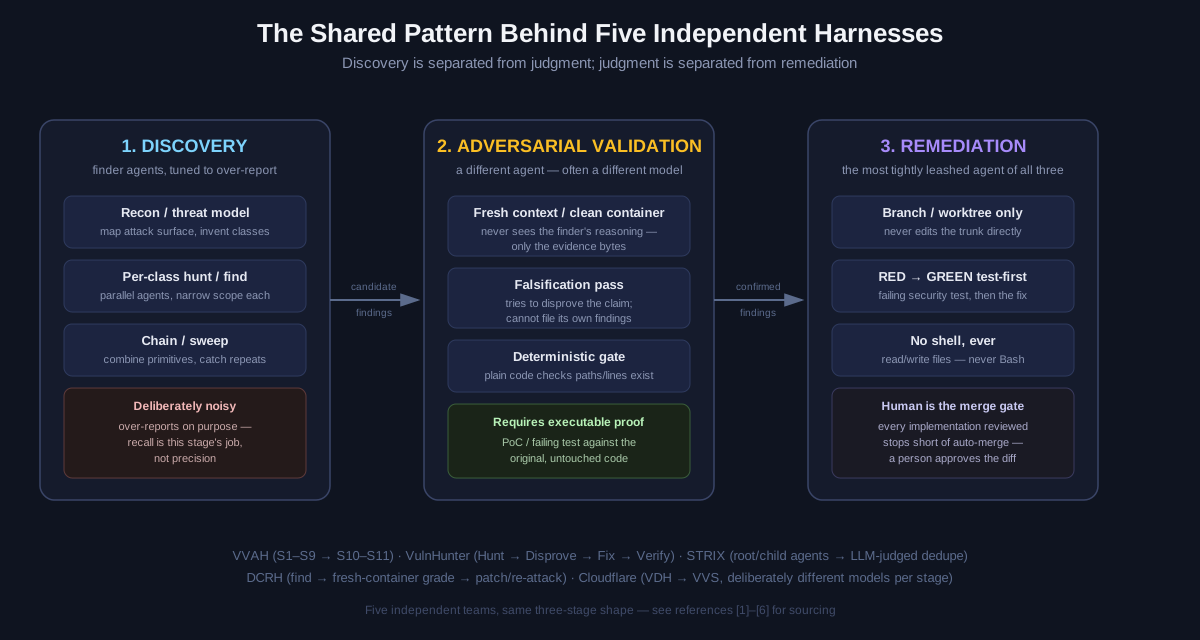
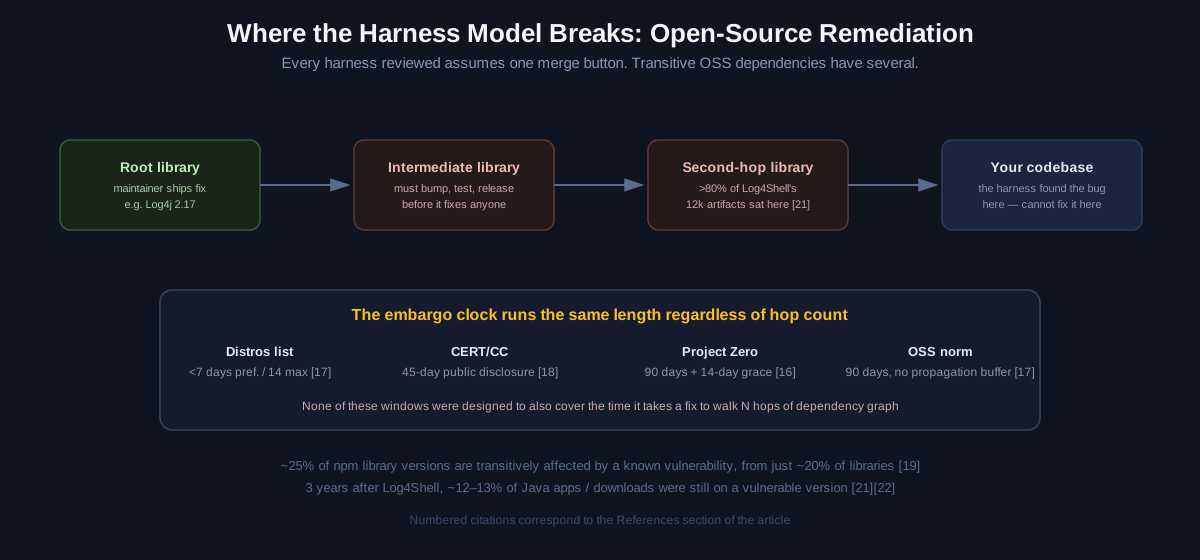
The five harnesses, at a glance
| Harness | Built by | Status | Core mechanism |
|---|---|---|---|
| VVAH Visa Vulnerability Agentic Harness | Visa | Open source (Apache 2.0) | 11-stage pipeline (S0–S11), config-selectable backend per role |
| VulnHunter | Capital One | Open source | 3 Claude Code skills: Hunt → Fix → Verify, zero agent framework |
| STRIX | Independent OSS | Open source | Root/child agent tree, shared Docker sandbox, OpenAI Agents SDK |
| DCRH Defending Code Reference Harness | Anthropic | Open source (reference) | Find → fresh-container grade → patch/re-attack, direct CLI subprocess |
| VDH / VVS Vulnerability Discovery Harness / Vulnerability Validation System | Cloudflare | Internal | 8-stage discovery loop feeding a shared, multi-harness triage system |
| OCR Open Code Review (control, non-Glasswing) | Alibaba | Open source | Code review, not vuln discovery — same deterministic-scaffold pattern, independently arrived at |
Source design docs
The underlying design documentation reviewed for each harness — HLD/LLD, module references, data flows, and operating runbooks. Each hub links every document in its set.
VVAH
11-stage pipeline (S0–S11) — design, modules, process runbooks, and graph-intelligence tooling.
Read the overview → All docs →VulnHunter
Hunt → Fix → Verify skills — design (incl. deterministic-vs-LLM), modules, and the Visa comparison.
Read the overview → All docs →STRIX
Root/child agent tree — agentic framework design, module reference, and operating processes.
Read the overview → All docs →DCRH
Reference harness — architecture overview, HLD/LLD, and patch-and-verify runbooks.
Read the overview → All docs →Open Code Review
The non-Glasswing control — code-review harness sharing the same deterministic-scaffold pattern.
Read the overview → All docs →Consolidated references
- Visa, Visa Vulnerability Agentic Harness (VVAH) — github.com/visa/visa-vulnerability-agentic-harness, open-sourced June 10, 2026 under the Apache License 2.0 (© 2026 Visa, Inc.).
- Capital One, VulnHunter — github.com/capitalone/VulnHunter
- STRIX, open-source autonomous penetration-testing agent — architecture and design documentation reviewed for this analysis.
- Anthropic, Defending Code Reference Harness (DCRH) — github.com/anthropics/defending-code-reference-harness
- Cloudflare, "Project Glasswing: what Mythos showed us," The Cloudflare Blog, May 18, 2026.
- Cloudflare, "Build your own vulnerability harness," The Cloudflare Blog, June 18, 2026.
- Anthropic, "Project Glasswing: Securing critical software for the AI era," April 7, 2026.
- Anthropic Frontier Red Team, "Mythos Preview" — red.anthropic.com/2026/mythos-preview, cited via ref 7.
- Alibaba, Open Code Review (OCR) — github.com/alibaba/open-code-review
- CyberGym cybersecurity vulnerability-reproduction benchmark result, cited via ref 7.
- ISC2, 2025 Cybersecurity Workforce Study.
- DeepStrike, "Cybersecurity Skills Gap Statistics for 2025: Record 4.8M Roles Unfilled."
- Splunk, 2025 State of Security, cited via industry workforce-automation roundups.
- Proofpoint, Voice of the CISO 2025, cited via industry burnout roundups.
- SANS, 2026 Cybersecurity Skills Report, via Industrial Cyber.
- Google Project Zero, "Policy and Disclosure: 2025 Edition."
- GitHub Blog, "Coordinated vulnerability disclosure (CVD) for open source projects."
- kernel.org, "How we coordinate embargoed releases."
- "Original Sin of npm: A Study on Vulnerability Propagation in JavaScript Dependency Networks," arXiv.
- Empirical study on open-source vulnerability remediation-time trends (2017–2024), cited via secondary industry summaries.
- Open Source Insights (deps.dev), "Understanding the Impact of Apache Log4j Vulnerability."
- Vulert, "Log4Shell 2026: Is Your Application Still Vulnerable?"
- Black Duck / Synopsys, 2026 OSSRA Report: Open Source Security & Risk Analysis.
- HeroDevs, "81,000 Open Source Package Versions Have Known CVEs and No Patch."
- OASIS, Static Analysis Results Interchange Format (SARIF) v2.1.0 — docs.oasis-open.org/sarif/sarif/v2.1.0