High-Level Design (HLD)
Companion diagram:
diagrams/01_architecture.svg. Interactive version:architecture.html— click any module box in §7 there for a full paragraph per module: what actually happens, exactly how (or whether) a model is called, and which parts are deterministic vs. AI-driven.
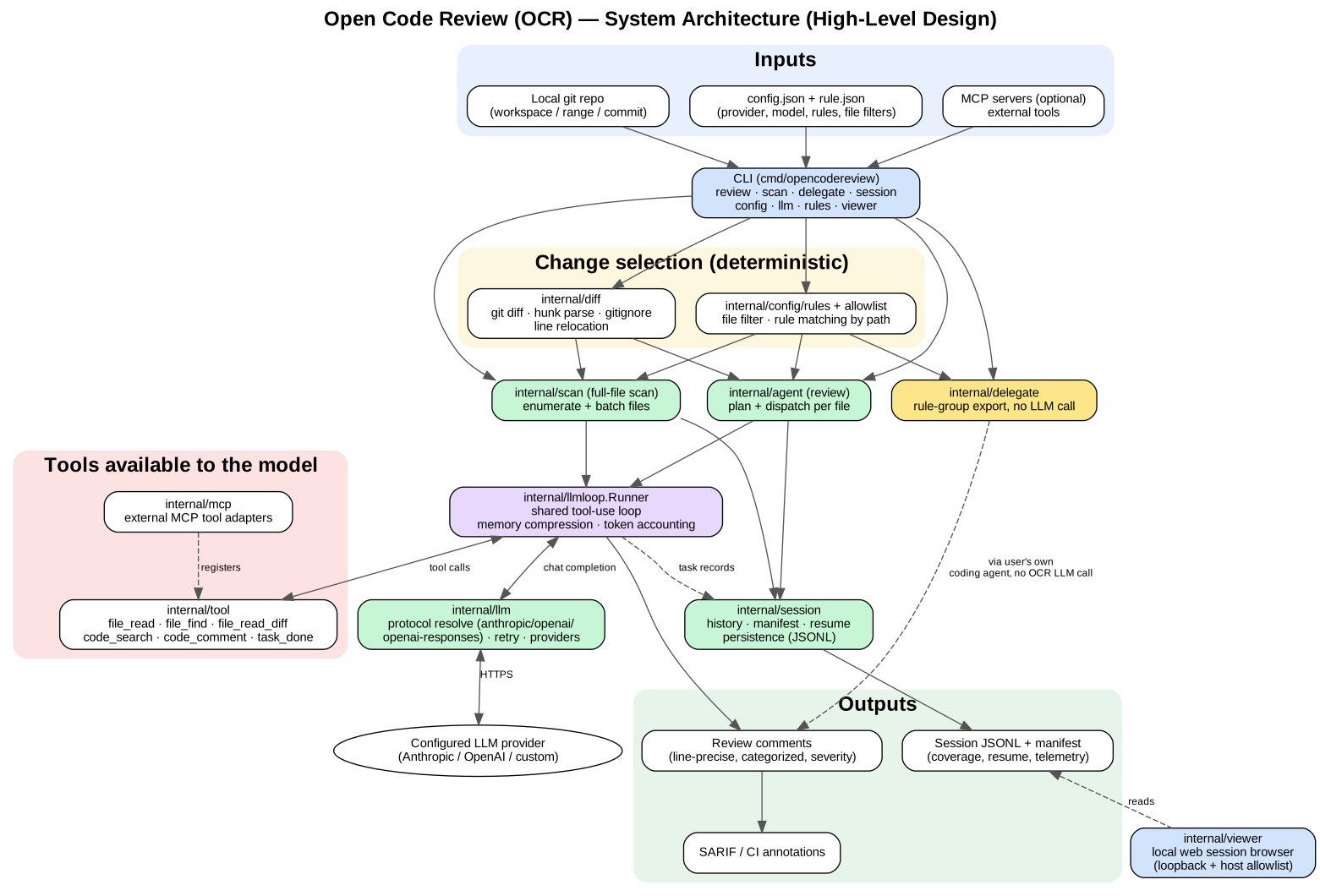
Open Code Review (OCR) is a command-line application. You run one command (ocr) with
a subcommand (review, scan, delegate, ...) and it looks at your local git repository.
Internally, think of it as an editorial desk: an intake clerk (the CLI) decides which
files are even in scope and what the house style is for each one, a desk editor
(review/scan agent) hands one file at a time to a staff writer (the LLM tool-use loop),
who can call out to a research assistant (the tool registry — read a file, search the
codebase) before filing a comment, and every comment that comes back is fact-checked
against the real diff before it's accepted. In delegation mode, the desk editor instead
hands the assignment straight to a writer you already employ elsewhere (your own coding
agent) and never talks to a model itself.
git repo · config.json · rule.json"] --> CLI["CLI (cmd/opencodereview)"] CLI --> DIFF["internal/diff
git diff / hunk parse / relocation"] CLI --> RULES["internal/config
rules · allowlist · templates"] DIFF --> AGENT["internal/agent (review)
internal/scan (full-file)"] RULES --> AGENT CLI --> DELEGATE["internal/delegate
no LLM call"] AGENT --> LOOP["internal/llmloop.Runner
shared tool-use loop"] LOOP <--> TOOLS["internal/tool + internal/mcp
file_read · search · code_comment"] LOOP <--> LLM["internal/llm
protocol resolve · retry"] LLM <--> PROVIDER(["LLM Provider API"]) LOOP --> SESSION["internal/session
history · manifest · resume"] SESSION --> OUT["Comments · SARIF · session JSONL"] SESSION --> VIEWER["internal/viewer
local web browser"] DELEGATE -. "via user's own agent" .-> OUT
1. Components and responsibilities
| # | Component | Package | Responsibility |
|---|---|---|---|
| 1 | CLI | cmd/opencodereview |
Cobra command tree (review, scan, delegate, session, config, llm, rules, viewer, completion); resolves the LLM endpoint, loads config/rules, builds and dispatches to the right agent. |
| 2 | Diff engine | internal/diff |
Git diff retrieval (workspace/range/commit), unified-diff parsing, .gitignore filtering, comment line-number resolution/relocation. |
| 3 | Config & rules | internal/config/{rules,allowlist,template,toolsconfig} |
Path-based rule resolution, file-type allowlist, prompt templates (task_template.json, scan_template.json), tool enable/disable config. |
| 4 | Review agent | internal/agent |
Orchestrates ocr review: load diffs → filter → dispatch per file → finalize the coverage manifest. |
| 5 | Scan agent | internal/scan |
Orchestrates ocr scan: enumerate whole files → same dispatch pattern → optional dedup + project-summary passes. |
| 6 | Delegate | internal/delegate |
Deterministic file selection + rule-group export for ocr delegate — makes no LLM call. |
| 7 | LLM loop | internal/llmloop |
The shared tool-use conversation loop (Runner.RunPerFile) both agent and scan dispatch into; memory compression; token accounting. |
| 8 | Tools | internal/tool |
The fixed toolset: file_read, file_find, file_read_diff, code_search, code_comment, task_done, plus the registry that also holds MCP tools. |
| 9 | MCP client | internal/mcp |
Adapts external MCP-server tools into the same tool registry the built-ins use. |
| 10 | LLM transport | internal/llm |
Resolves provider/protocol/model (env → config → preset); speaks Anthropic / OpenAI Chat Completions / OpenAI Responses; retries with backoff. |
| 11 | Session | internal/session |
Per-run JSONL history + the immutable coverage manifest that powers --resume. |
| 12 | Viewer | internal/viewer |
Local-only web server rendering a session's history as browsable HTML. |
| 13 | Telemetry | internal/telemetry |
Opt-in OpenTelemetry spans/metrics — never load-bearing for a review's result. |
2. Technology stack
- Language / runtime: Go ≥ 1.25 (module
github.com/alibaba/open-code-review). - Diff/VCS: shells out to the system
git(≥ 2.41) — no embedded git library; every invocation uses a hardcoded subcommand list and--end-of-options, never a shell. - AI transports:
github.com/anthropics/anthropic-sdk-go,github.com/openai/openai-go/v3, plus a raw OpenAI-Responses-protocol client — selected byinternal/llm's protocol resolution, not hardcoded to one vendor. - Extensibility: Model Context Protocol (
github.com/modelcontextprotocol/go-sdk) for externally-provided tools. - CLI:
spf13/cobra+spf13/pflag. - TUI:
charm.land/bubbletea/bubbles/lipgloss(the interactive provider/model setup wizard,cmd/opencodereview/provider_tui.go). - Observability:
go.opentelemetry.io/otel(OTLP gRPC/HTTP exporters), opt-in. - Build:
CGO_ENABLED=0— static binaries, no C attack surface, distributed via npm (@alibaba-group/open-code-review), an install script, and GitHub Releases.
3. Run / distribution model
OCR ships as a single static binary, installable via npm install -g
@alibaba-group/open-code-review, an install script, or a GitHub Release download — plus
integrations that don't require installing the binary at all: a GitHub Action
(action.yml), CI examples for GitLab/Bitbucket/Gerrit/CodeUp/GitFlic
(examples/), a VS Code extension (extensions/vscode/), and coding-agent plugins for
Claude Code, Codex, Cursor, OpenCode, and QCA Forward (plugins/open-code-review/).
Configuration resolves in this order (per internal/llm/resolver.go): environment
variables (OCR_LLM_PROTOCOL etc.) → config.json's llm.protocol (or the legacy
use_anthropic boolean) or a named built-in provider preset (anthropic, openai, or a
custom provider entry) → the endpoint's model/token. rule.json layers custom → project →
global → system rule text, first match wins per file.
4. Trust boundaries & security posture (design-level)
Summarized from the project's own ASSURANCE_CASE.md (source-verified):
- Every external process call is
git, hardcoded, no shell. Command injection via a crafted diff is mitigated by never building a shell command string —exec.Commandalways gets an explicitgit+ fixed subcommand +--end-of-options. - API keys never touch disk or logs. Read only from environment variables; never written to config files, output files, or telemetry.
- Every LLM-suggested file path is validated against the repo root (
pathutil.WithinBase, both before and after symlink resolution) before any tool reads or writes it — mitigates path traversal from a model hallucinating or being tricked into requesting../../etc/passwd. - The local session viewer defends against DNS rebinding, not just XSS: a Host-header
allowlist rejects non-loopback origins by default, on top of
html/templateauto-escaping and a strict CSP. - TLS 1.2+ with full certificate verification always —
InsecureSkipVerifyis never set anywhere in the codebase.
5. Quality mechanisms
- Deterministic + AI hybrid at every layer, not just at the edges: file selection, rule
matching, comment line-number resolution, and coverage/manifest bookkeeping are all plain
code wrapped around the one AI-driven step (the tool-use loop) — see
architecture.html§7 for the exact deterministic/AI split per package. - Optional review-filter pass — a second LLM pass that can drop the model's own low-value comments before they're reported.
- Bounded concurrency + per-run token budget —
--max-tokens-budgetstops dispatching new files (not cancelling in-flight ones) once the projected total would exceed the cap, so an overrun is bounded by the concurrency limit (default 8), never a whole extra batch. - Resumability —
--resumematches a prior run's completed items by a content fingerprint (SHA-256 of mode + paths + diff text), so a moved/renamed ref or changed diff content correctly forces a re-review instead of silently reusing stale results. - 90% test coverage enforced in CI (
make coverage, perAGENTS.md), plusgo vet,govulncheck, and the Go race detector on every push/PR.
6. The shared execution engine — internal/llmloop.Runner
Both ocr review and ocr scan dispatch into the same per-file tool-use loop
(internal/llmloop.Runner.RunPerFile) rather than each having its own copy — this is the
one piece of machinery every review, of either mode, actually runs through.
In plain terms: think of the Runner as a single conversation moderator that both the "diff review" desk and the "full-file scan" desk share. It doesn't know or care which desk called it; it just runs the same loop — send the conversation, execute whatever tools come back, track how big the conversation is getting, stop when the model says it's done or the budget runs out — and reports back what happened.
- Model/vendor selection happens entirely in the caller (
agent.Args.Model/scan.Args.Model, set once by the CLI frominternal/llm.ResolveEndpointWithOptions) and is passed intollmloop.Deps.Model— the Runner itself makes no routing decision. - Permission story: the Runner does not distinguish tool permissions by caller — every
file review, whether from
agentorscan, gets the same fixed toolset (MainToolDefs, built once at CLI startup from the enabled built-in tools plus any registered MCP tools). There is no read-only-vs-write-capable split the way a propose-a-fix agent would need, because OCR's tools are inherently read-only except for the one designed side effect,code_comment(append a finding), which never edits the file under review. - Loop/turn budget:
Template.MaxToolRequestTimesrounds, after which a final grace round offers the model onlycode_commentandtask_done— a last chance to report findings it already has, not to keep investigating. - Context-size guardrail: three-zone token compression at 60%/80% of
Template.MaxTokens(internal/llmloop/compression.go) — synchronous once the hard threshold is hit, background otherwise — is what keeps a long tool-call conversation from silently exceeding the model's context window.
See data-flow for the artifact-by-artifact flow through this loop, and
architecture.html §7 (llmloop box) for the exact stop conditions.