Graph Intelligence — How the Graphs Were Built
To understand OCR beyond what's inferable from the README, we ran two local, no-API-key
code-intelligence tools over the actual Go source in
samples/open-code-review/ and used their real output to
verify the module map and diagrams rather than guessing at package structure. Raw exports
live under tool-outputs/ — see its
README for full detail; this page is the how/why.
What we ran
CodeGraph (@colbymchenry/codegraph)
A tree-sitter + SQLite knowledge-graph builder. Indexed the full repo.
| Metric | Value |
|---|---|
| Files indexed | 435 (278 Go + JS/TS/Python/YAML doc tooling) |
| Nodes | 7,416 (3,173 functions · 866 methods · 220 structs · 66 interfaces · 59 classes · 1,989 imports) |
| Edges | 23,976 (10,883 calls · 7,403 contains · 2,466 instantiates · 1,927 references · 1,250 imports · 47 implements) |
We queried the SQLite index directly (no built-in "module dependency" export command in
this CodeGraph version) with
tools/gen_module_dependencies.py — a small,
reusable script that aggregates call/reference edges by top-level Go package
(internal/<pkg> or cmd/<pkg>) and ranks symbols by call-in fan-out. Output:
tool-outputs/codegraph/module_dependencies.json,
which drives diagrams/04_module_dependencies.svg.
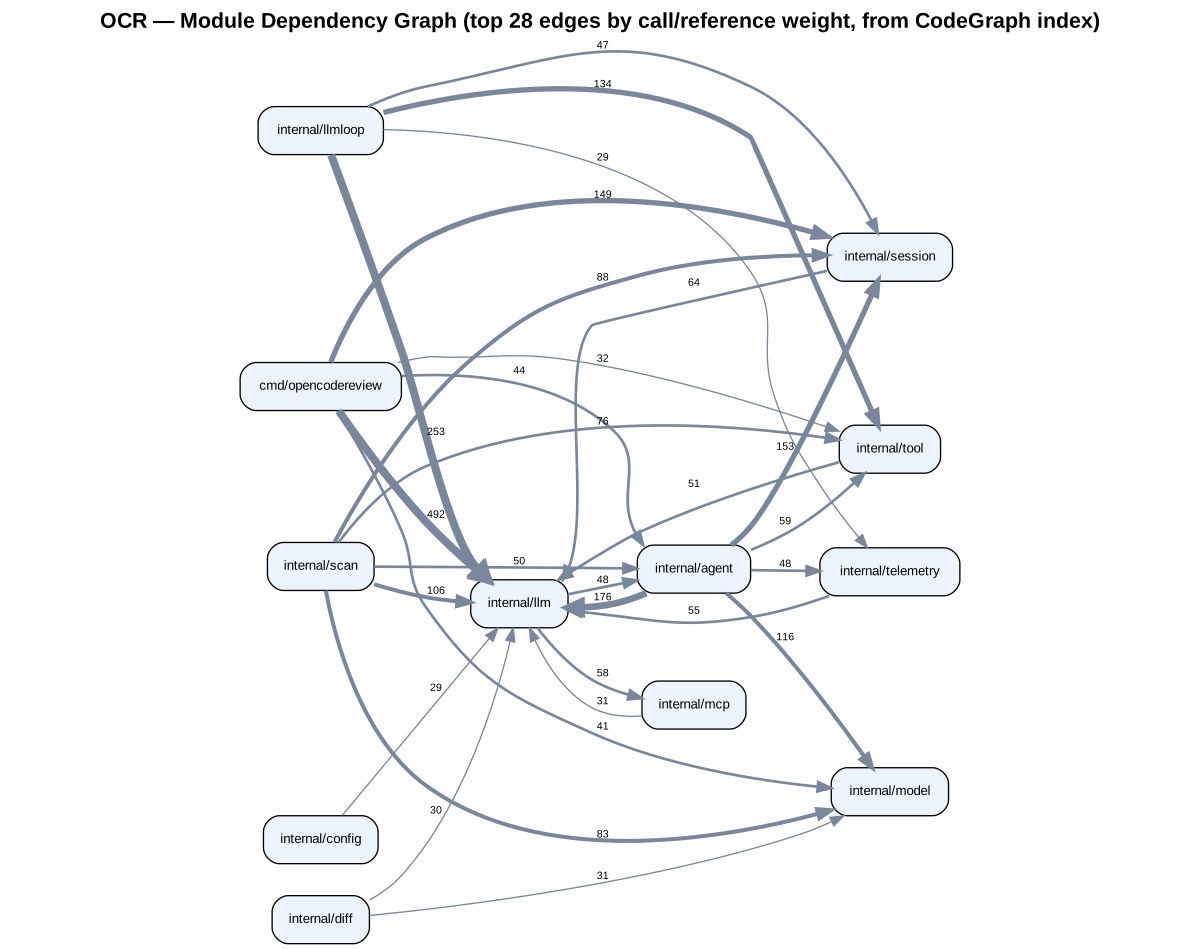
The highest-fan-in ("god") symbols confirm the design read from source: internal/llm.Error
(the shared retry-boundary error wrapper, 793 in-calls — every provider call funnels through
it), internal/session.New and internal/agent.New (session/agent bootstrap), and
internal/tool.NewRegistry/Register (every tool wire-up point).
Graphify (graphifyy)
A NetworkX + Leiden clustering knowledge-graph builder. Ran the code-only pass
(graphify update, no LLM API key configured or needed for AST extraction).
| Metric | Value |
|---|---|
| Nodes | 4,448 (3,591 touch .go files) |
| Edges | 6,670 |
| Communities | 341 (299 touching .go files) |
A note on this run's cluster granularity. Graphify's Go extraction in this environment
produced file-level nodes (one node per .go file, not one per function/struct symbol as
its Python extraction typically does), so its Leiden communities land close to 1:1 with
source files rather than forming the broad cross-file thematic clusters seen when Graphify
runs on a Python codebase. Rather than ship 299 nearly-meaningless "Community N" labels, we
derived a package-level rollup — same "never ship raw output" rule as any graph tool —
in tool-outputs/graphify/graphify_communities_summary.md:
the 40 largest communities, each with its dominant Go package and example files. Every
internal/* package (scan, session, llm, llmloop, diff, tool, config, ...)
does appear as its own dominant cluster, which is the useful confirmation — the CodeGraph
module-edge data above is the primary source for the actual dependency diagram.
Readable views we built
| File | What it gives you |
|---|---|
architecture.html |
Interactive explainer — Simple/Technical toggle, review-lifecycle stepper, 13 module boxes each answering "what happens / how the model is chosen / what's deterministic". |
diagrams/module-graph.html |
Same 13-module flow, standalone (no narrative sections) — for sharing just the map. |
tool-outputs/README.md |
Index of every raw export, cross-checked against the docs written from source reading. |
Tools not run here
Same gap as any sandboxed build: Serena (LSP-backed symbol navigation) needs a running
Go language server, and grepai (embedding-based semantic search) needs a local or
remote embedding provider (e.g. Ollama). Neither is configured in this environment. Setup
is unchanged from the Visa project's own docs/tools/graph-intelligence.md — point either
at samples/open-code-review/ once you have a local Go LSP / Ollama running:
# Serena — symbol-level navigation over the Go package
uv tool install -p 3.13 serena-agent && serena init
# then ask your MCP-connected agent to use find_symbol / find_referencing_symbols
# over samples/open-code-review/internal/

# grepai — semantic search
brew install yoanbernabeu/tap/grepai && ollama pull nomic-embed-text
cd samples/open-code-review && grepai init && grepai watch &
grepai search "where does OCR decide which files are eligible for review"
How to refresh these graphs after code changes
CodeGraph and Graphify both need to build their SQLite/JSON indexes on local disk — a
networked or FUSE-mounted project folder can hit disk I/O error on codegraph init.
Index a local copy, then copy just the derived JSON/Markdown outputs back:
rsync -a samples/open-code-review/ /tmp/ocr-work/ --exclude .codegraph --exclude .graphify
cd /tmp/ocr-work

npx -y @colbymchenry/codegraph init . -f
python3 <path-to-project>/tools/gen_module_dependencies.py \
  --db .codegraph/codegraph.db --out module_dependencies.json

npx -y graphifyy update .   # code-only pass, no LLM key needed

# copy module_dependencies.json, .graphify/graph.json, .graphify/GRAPH_REPORT.md,
# and .codegraph/codegraph.db back into tool-outputs/{codegraph,graphify}/
Then re-render the diagrams: dot -Tsvg diagrams/src/04_module_dependencies.dot -o
diagrams/04_module_dependencies.svg (regenerate the .dot from the refreshed JSON first if
the top-N edges changed), and re-run python3 tools/generate_architecture_html.py if any
module's narrative changed.