Tool outputs — index
Raw exports from the two local, no-API-key code-intelligence tools run against
samples/open-code-review (a pinned local clone of
alibaba/open-code-review). Raw output is not
the deliverable on its own — see the curated, human-readable views listed at the bottom of
each section. Regeneration commands are in docs/tools/graph-intelligence.md.
CodeGraph (@colbymchenry/codegraph)
A tree-sitter + SQLite knowledge-graph builder.
| Metric | Value |
|---|---|
| Files indexed | 435 (278 Go, plus JS/TS/Python/YAML docs tooling) |
| Nodes | 7,416 (3,173 functions · 866 methods · 220 structs · 66 interfaces · 59 classes · 1,989 imports) |
| Edges | 23,976 (10,883 calls · 7,403 contains · 2,466 instantiates · 1,927 references · 1,250 imports · 47 implements) |
Files:
- codegraph/codegraph.db — the raw SQLite index (queryable with codegraph query/node/explore, or directly with sqlite3).
- codegraph/status.json — index stats as of generation time.
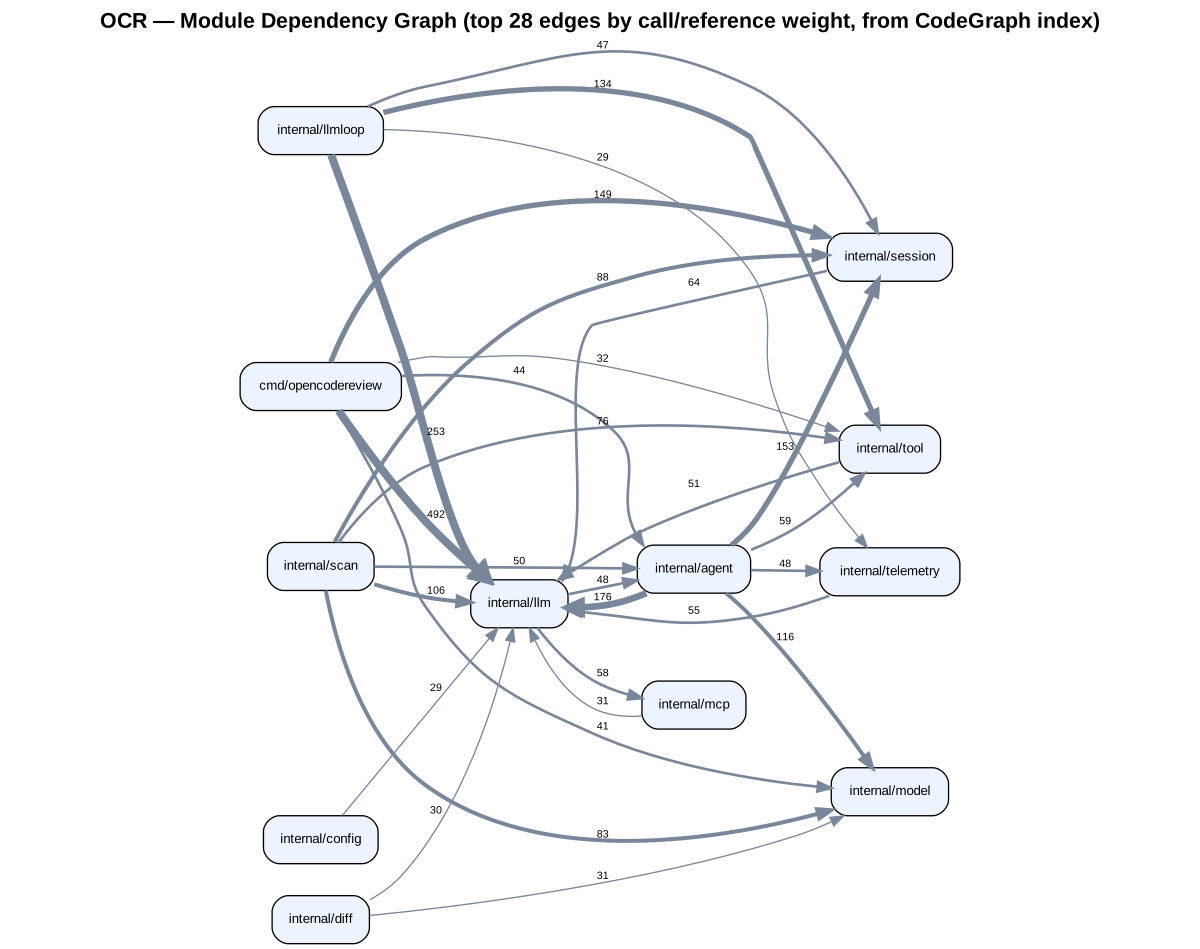
- codegraph/module_dependencies.json — aggregated package-to-package call/reference edges, derived by tools/gen_module_dependencies.py. This is what powers diagrams/04_module_dependencies.svg.
- codegraph/top_god_symbols_nontest.json — the 25 most-called non-test symbols. Confirms the architecture read from source: internal/llm.Error (the shared retry-boundary error wrapper, 793 in-calls) and internal/session.New / internal/agent.New are the highest fan-in "god" symbols — exactly the shared plumbing (retry handling, session bootstrap) every review touches.
Graphify (graphifyy)
A NetworkX + Leiden clustering knowledge-graph builder. Ran the code-only pass (graphify update, no LLM key configured — matches the VVAH build's "code AST pass without the optional LLM naming step").
| Metric | Value |
|---|---|
| Nodes | 4,448 (3,591 touch .go files) |
| Edges | 6,670 |
| Communities | 341 (299 touching .go files) |
| Note | Without an LLM naming step, and at file-level granularity (Graphify's Go extraction groups by file, not by function/struct symbol), communities cluster close to 1:1 with source files rather than forming large cross-file thematic groups the way VVAH's Python community graph did. |
Files:
- graphify/graph.json — the raw NetworkX-exported graph (nodes/links/communities).
- graphify/GRAPH_REPORT.md — Graphify's own generated report.
- graphify/graphify_communities_summary.md — the largest 40 communities, each with its dominant Go package and example files (deterministic naming, no LLM call — same "never ship raw output" rule as VVAH). Confirms every internal/* package clusters together as expected: internal/scan, internal/session, internal/llm, internal/llmloop, internal/diff, internal/tool all appear as their own dominant-package clusters.
Cross-check against source reading
Both tools' module-edge and fan-in data corroborate the architecture documented in
docs/design/HLD.md and docs/design/data-flow.md,
which were written from direct source reading (cmd/opencodereview, internal/agent,
internal/scan, internal/llmloop, internal/llm, internal/tool, internal/diff,
internal/session, internal/mcp, internal/delegate, internal/viewer) — the graph data
was cross-referenced against those docs, not used as a substitute for reading the code.
The two tools not run here
Same as the VVAH build: Serena (LSP-backed symbol navigation) and grepai (embedding
semantic search) both need a locally running provider (a language server / an embedding
model) that this sandbox does not have configured. Setup steps are the same as documented in
the Visa project's docs/tools/graph-intelligence.md — point either tool at
samples/open-code-review/ once you have a local Go language server / Ollama running.